

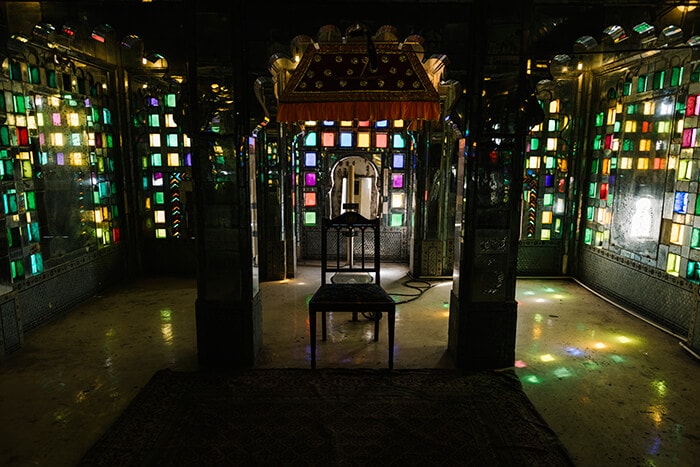
Stained glass windows, showing the different colors of light passing through the glass, a common type of optical filter.
Think of color gels over lights or stained glass windows – these are the most common type of filters which alter the color composition of the light passing through them – they do this by reducing or removing specific wavelengths of light. Another type of filter you are almost certain to be very familiar with is sunglasses, which reduce all wavelengths of light by the same amount to dim a very bright scene. Some of the other types of filter included in this paper are diffusers, which change the spatial properties of light, and polarization which allow one axis of light to pass through and block the other axis. The most common polarization you would be familiar with are the lenses in your glasses at a 3D format movie – the lenses are polarized so that each eye sees something slightly different, giving the 3D effect that fools your brain. In the image below, a polarizer is placed on the camera lens and rotated 90° between the two images.
What difference a filter makes – polarizing filter on the camera used to take this image removes the reflection.
In the case of depth cameras, these different filters can be used to optimize and improve the camera output in specific situations, by helping tune in to the wavelengths and colors of light that are most useful for that specific environment. Learn more and read the full whitepaper here.