

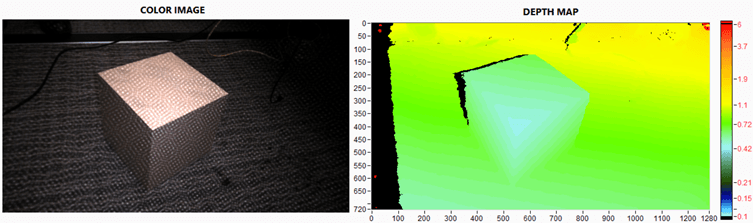
 Figure 1. The output of a depth camera. Left: Color Image of a cardboard box on a black carpet. Right: Depth map with faux color depicting the range to the object
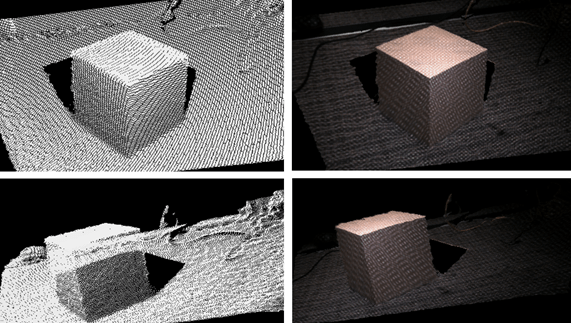
Figure 2. The 3D Point Cloud of the box captured in Fig 1. Left shows 3D mesh without color texture, and right shows the same scene with the image color texture applied. The top and bottom are different views seen by rotating the point-of-view. Note that this is a single capture, and not simply photos taken from different viewpoints. The black shadow is the information missing due to occlusions when the photo was taken, i.e. the back of the box is of course not visible.
RealSense™ Stereo Depth Camera D400 Family
We been developing depth sensing solution based on almost every variant of depth sensing technology for several years, and all technologies have their technological tradeoffs. Of all the depth sensing technologies, stereo vision is arguably the most versatile and robust to handle the large variety of usages. While one could be tempted to think that stereoscopic vision is “old-school” technology, it turns out that many of the challenges faced by stereo depth sensing in the past have only now been overcome – algorithms were not good enough and prone to error, computing the depth was too slow and costly, and the systems were not stable over time. We have greatly accelerated computing stereo depth by creating custom silicon for depth sensing, the RealSense Vision Processor D4 and D4m, that can achieve calculation speeds of over 36 Million depth points/second using a customized variant of a Semi Global Matching algorithm, achieving frame rates of >90fps, using less than 22nW/depth-point in a chip package size of 6.3×6.3mm (which is a fraction of that of the Core™ i7 processor), and searching across 128 disparities. The goal was to enable computer stereo vision to achieve performance levels (power, thermals, resolution, frame rate, size, cost etc.) needed for embedding in small consumer electronic devices such as mobile phones, drones, robots, and surveillance. With this goal in mind, launched its 2nd Generation ASIC, the RealSense Vision Processor D4, that shows great improvements especially in environments where the projected light of any active system (assisted stereo, structured, or ToF) would be washed out or absorbed, outside or on dark carpets that tend to absorb IR light, as seen in Fig 3.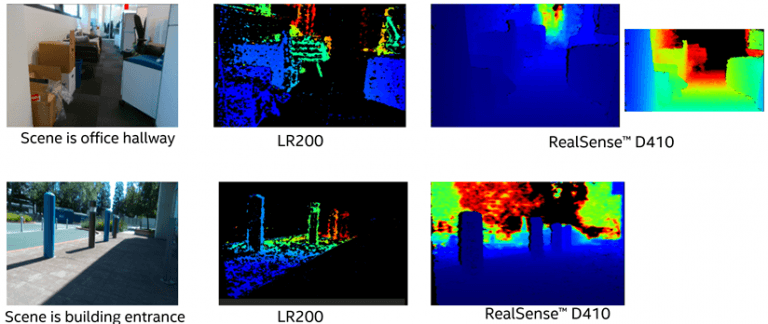 Figure 3. Example scenes comparing the previous generation LR200 Module vision processor performance with the new D410 Module and vision processor showing the vast improvement in one chip generation.
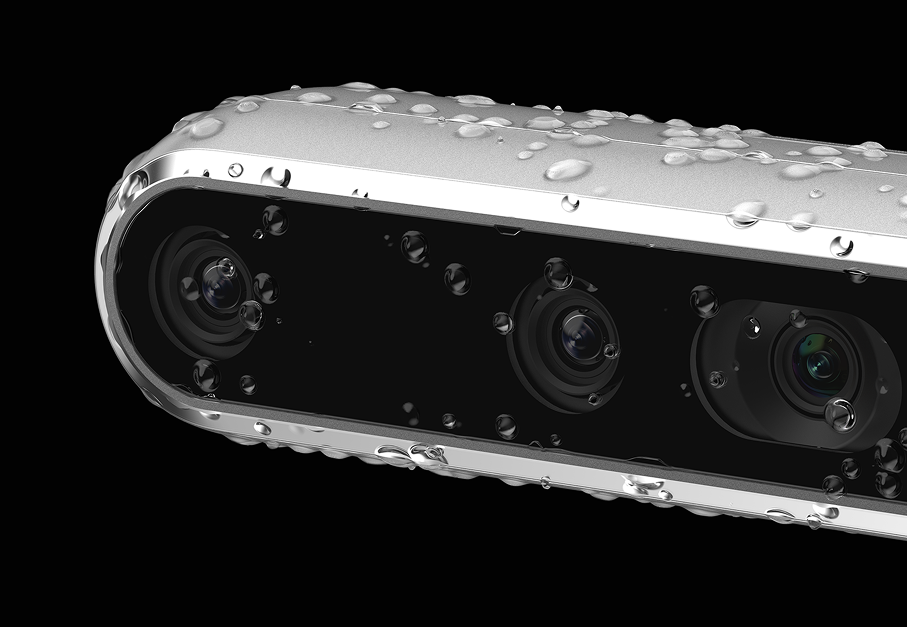
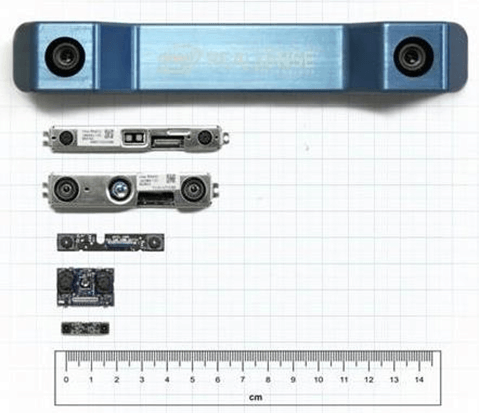 Figure 4. A collection of RealSense™ D400 camera modules that all use the same ASIC.